
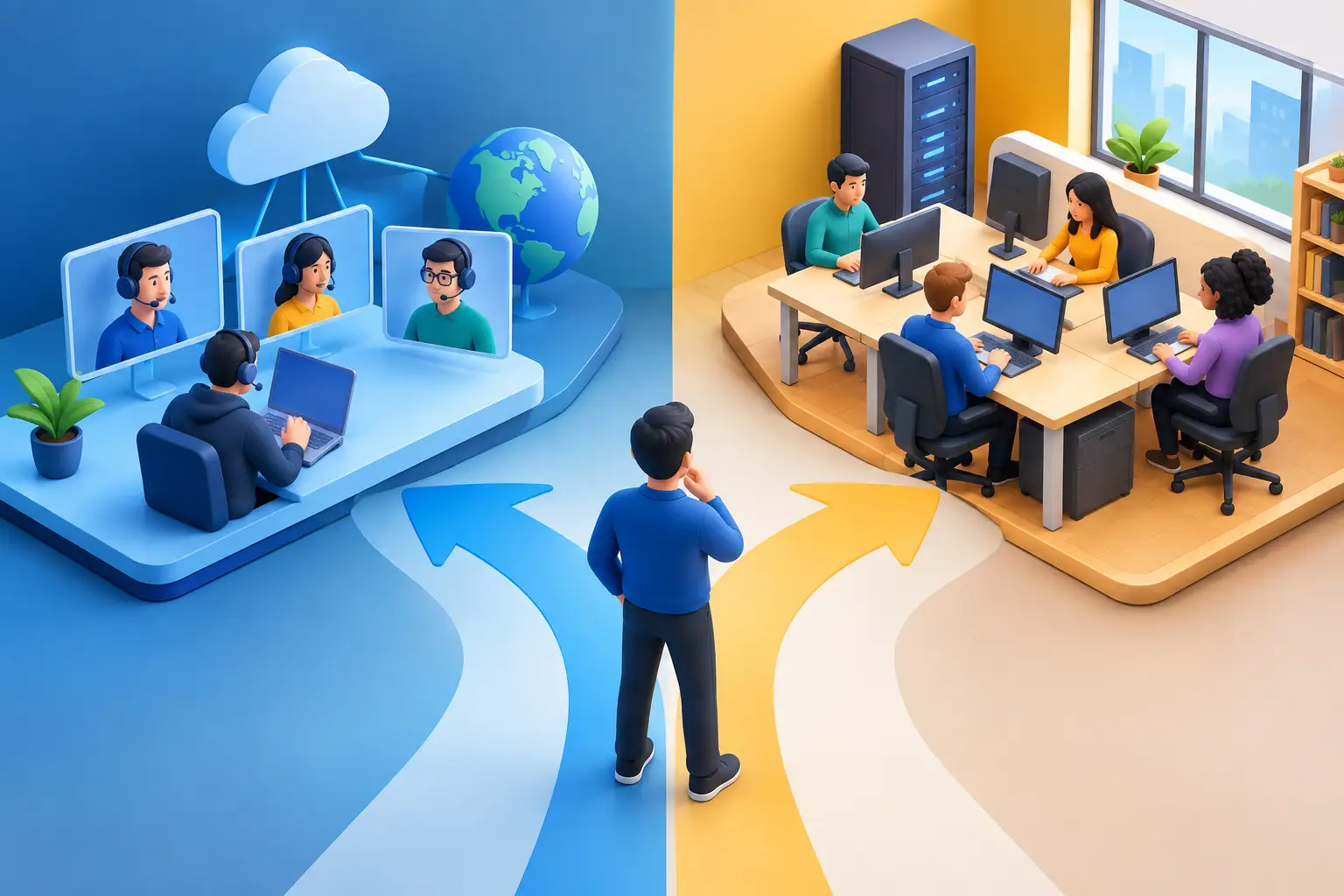
Outsourced IT Versus Internal: Which Fits?
A server outage at 8:15 a.m. is not a technology problem alone. It is a delayed payroll run, a disrupted client meeting, an unavailable line-of-business application, and a team waiting for answers. That is why the decision between outsourced IT versus internal IT should be based on the operational coverage your organization needs, not simply on who can respond to the next help desk ticket.
For many organizations, an internal IT employee brings valuable familiarity with users, workflows, and company priorities. An outsourced IT provider brings broader technical depth, around-the-clock coverage, and a structured model for prevention, security, and planning. The right answer may be one or the other, but it is often a combination of both.
Outsourced IT versus internal: Start with business risk
The central question is not whether an internal technician or an outside provider is better. It is whether your current IT model can protect productivity, data, and business continuity as your organization changes.
An internal team can be highly effective when it has the right staffing level, leadership support, specialized skills, and budget. But even a capable one-person or two-person department has practical limits. Vacation, illness, competing priorities, and the need to support every application and device can leave important work waiting. Cybersecurity monitoring, patch management, vendor management, documentation, backup testing, and strategic planning are all demanding responsibilities. They should not become after-hours tasks that receive attention only when time permits.
Outsourced IT changes the coverage model. Instead of relying on a small number of individuals, the organization gains access to a team with defined service processes and specialized knowledge across support, networking, cloud infrastructure, cybersecurity, backup, and business continuity. For businesses that do not need or cannot justify a full internal department, this can turn IT from a reactive expense into a managed operating function.
That does not mean outsourcing is automatically the best fit. Organizations with deeply customized systems, internal development teams, or highly specialized operational technology may need dedicated internal expertise. The objective is to identify where internal knowledge is essential and where an experienced service partner can reduce risk and improve responsiveness.
What an internal IT team does well
Internal IT professionals understand the organization from the inside. They know which executive needs immediate assistance before a board meeting, which department relies on a legacy application, and where a process breaks down in the real world. That context matters, particularly when technology is closely tied to unique workflows.
An internal team also has direct visibility into company culture and business priorities. It can build relationships with employees, coordinate closely with operations leaders, and support projects that require frequent on-site involvement. In a larger organization, an internal IT department may be the appropriate owner for enterprise architecture, applications, data governance, or industry-specific systems.
The limitation is not competence. It is capacity and breadth. A single internal IT leader may be excellent at user support and infrastructure administration but have limited time to evaluate security alerts, test disaster recovery plans, negotiate with vendors, document systems, and develop a three-year technology roadmap. Hiring separate specialists for each responsibility can be costly and difficult, especially in the competitive Washington, DC-area technology market.
Internal IT also creates a key-person risk when critical knowledge lives with one employee. If that person leaves, the organization may lose access to passwords, configurations, vendor contacts, and institutional knowledge at the worst possible time. Clear documentation and shared processes are essential regardless of staffing model.
Where outsourced IT delivers greater value
A managed IT provider is built to deliver repeatable service across many technical disciplines. This typically includes end-user support, proactive monitoring, patching, endpoint protection, network administration, backup oversight, and regular reporting. Rather than waiting for a user to identify a failure, the provider monitors systems and addresses many issues before they interrupt work.
Cybersecurity is often the strongest reason to consider outsourced support. Threats do not keep office hours, and security tools require active configuration, review, and response. A provider can help establish layered protection through email security, multifactor authentication, endpoint security, vulnerability management, backup controls, and incident response procedures. For organizations handling regulated, confidential, or client-sensitive information, that disciplined oversight can be far more practical than assigning security to an already overloaded generalist.
Outsourcing also provides cost predictability. An internal hire involves salary, benefits, recruiting, training, retention risk, and potentially multiple hires as technology needs expand. A managed-service agreement creates a more consistent monthly technology cost while providing access to a broader bench of expertise. It does not eliminate all project costs, but it can make budgeting and long-term planning more reliable.
The best providers do more than close tickets. They explain risk in business terms, maintain an accurate technology inventory, prepare for lifecycle replacements, and help leadership make informed decisions about cloud services, communications, infrastructure, and continuity. CMA Technologies approaches managed services as an accountable relationship that combines daily support with technology strategy, security protection, and the practical systems that keep an office running.
The trade-offs leaders should consider
Outsourced IT requires a strong partnership. The provider will not know your business as deeply on day one as a long-tenured internal employee. Effective onboarding, documentation, recurring service reviews, and a clear escalation process are necessary to build that understanding. Organizations should expect their provider to ask detailed questions about workflows, applications, access requirements, compliance obligations, and future plans.
There can also be situations where on-site presence matters. A business with frequent hardware changes, complex facilities needs, multiple locations, or specialized equipment may need regular on-site support in addition to remote service. This is not a reason to rule out outsourcing. It is a reason to confirm that the service model includes the right on-site response, project resources, and expertise for physical-office technology such as wireless networks, structured cabling, cameras, conference rooms, or VoIP systems.
On the internal side, direct control can become a burden if leaders must manage staffing, technical priorities, tool selection, and emergency coverage without enough resources. The goal is not to preserve control over every technical task. It is to maintain accountability for business outcomes while ensuring qualified people are responsible for the work.
Co-managed IT is often the practical middle ground
The outsourced IT versus internal decision does not have to be all or nothing. Co-managed IT gives internal staff access to outside expertise, tools, and coverage while allowing them to remain closely involved in daily operations and strategic initiatives.
For example, an internal IT manager may retain ownership of business applications, employee relationships, and company-specific projects. The managed services partner can provide 24/7 help desk support, network monitoring, patching, security operations, backup oversight, documentation, and escalation support. This division lets internal staff focus on initiatives that move the organization forward instead of spending every day resetting passwords, troubleshooting printers, or responding to routine alerts.
Co-managed support also helps organizations scale without rushing into a series of permanent hires. A growing company can add users, locations, cloud services, or stronger cybersecurity controls with a service model that evolves alongside the business. It also provides continuity when internal staff are unavailable or when specialized project expertise is required.
Questions to ask before choosing a model
Leadership should begin with the gaps that create the most exposure. Can employees get knowledgeable support when they need it? Are critical systems monitored after hours? Are backups verified and recovery procedures tested? Who reviews security alerts, applies patches, manages access, and keeps documentation current? Can the organization explain its technology risks and investment priorities to the board, owners, or clients?
Next, evaluate what the business truly needs from internal IT. If the team is spending most of its time on maintenance and user requests, an outsourced partner may create room for higher-value work. If the organization relies on complex proprietary applications or constant hands-on coordination, internal expertise may remain essential, supported by outside specialists where needed.
Finally, measure providers by more than price. Ask how they handle escalation, how they document environments, what security controls are included, how they report performance, and who is accountable during an incident. A low monthly rate has little value if it leaves security, recovery, or strategic planning outside the agreement.
The right IT model is the one that gives your organization dependable support today and a credible plan for tomorrow. Whether that means a fully outsourced relationship, a strengthened internal department, or a co-managed approach, technology should reduce operational uncertainty rather than add to it.