
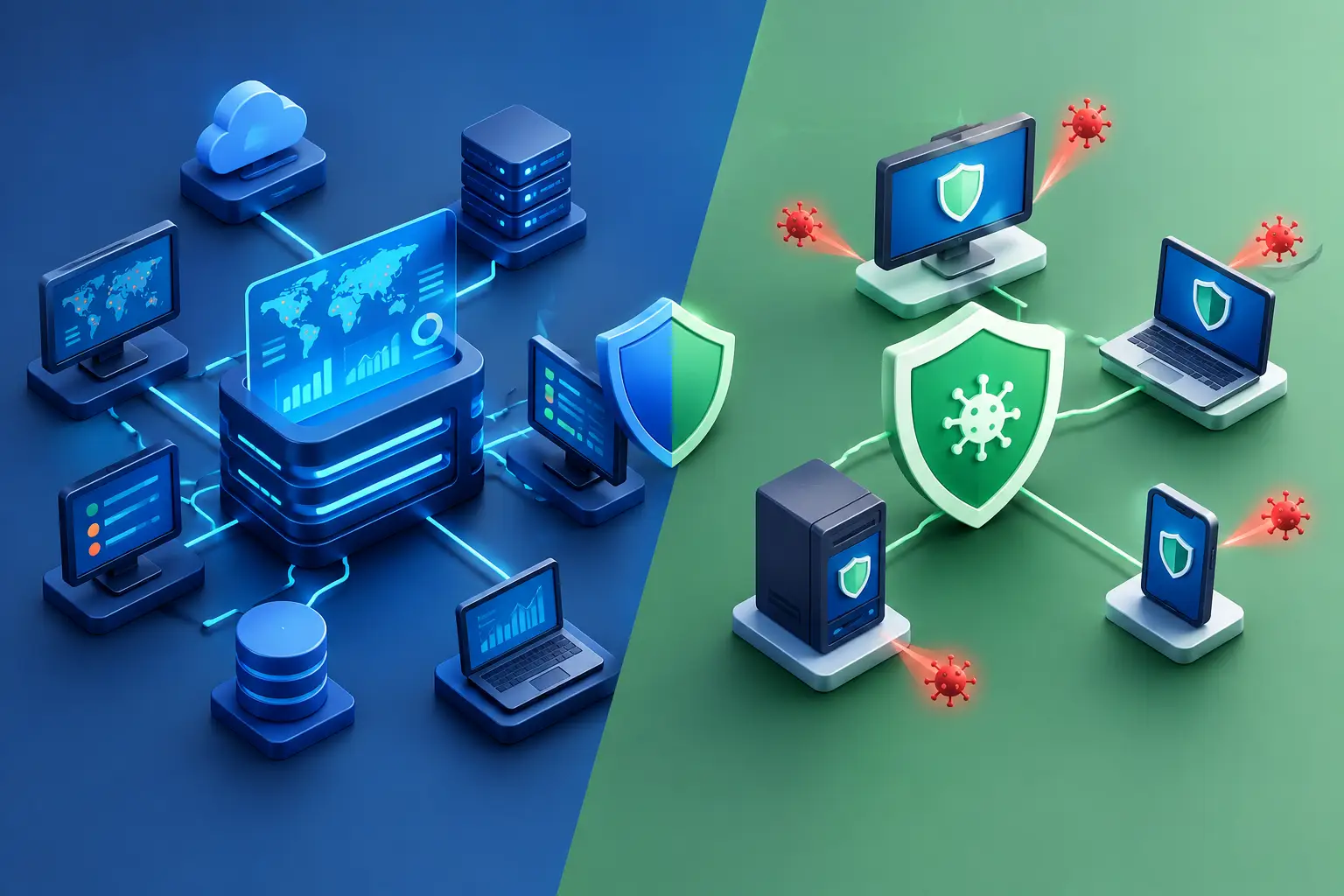
SIEM Versus Traditional Antivirus Compared
A ransomware alert at 2:00 a.m. rarely begins with a dramatic warning. It may start with a valid user account signing in from an unfamiliar location, an endpoint process behaving oddly, or a series of failed access attempts that appear harmless in isolation. That is where the discussion of SIEM versus traditional antivirus becomes practical for business leaders: these tools address different parts of the security problem.
Traditional antivirus remains necessary. It protects individual devices from known malicious files and suspicious behavior. A security information and event management platform, or SIEM, collects and analyzes security data from across the business to identify patterns that a single device cannot see. One is a frontline control. The other provides broader visibility and helps teams investigate and respond.
For organizations that depend on reliable systems, protected client data, and uninterrupted operations, the question is not simply which tool is better. It is whether the security program can detect, contain, and recover from the threats most likely to disrupt the business.
SIEM versus traditional antivirus: not an either-or decision
Antivirus software is installed on endpoints such as workstations, laptops, and servers. Its core job is to identify malware, block harmful files, scan systems, and alert administrators when it finds suspicious activity. Modern endpoint protection tools may also use behavioral analysis, cloud intelligence, and automated containment to identify threats that do not match a known malware signature.
That is valuable protection. If an employee opens a malicious attachment or downloads an infected file, endpoint security may stop the attack before it executes. It also gives IT teams a direct way to enforce device-level protections across the organization.
A SIEM works differently. It gathers logs and events from many sources, which may include firewalls, Microsoft 365, identity platforms, servers, cloud applications, network equipment, endpoint tools, and backup systems. It then correlates those events to surface activity that deserves attention.
For example, an antivirus tool might report that it blocked a suspicious process on one laptop. A SIEM can add context: the same user account logged in from a foreign IP address, accessed several file shares, and attempted to disable backup alerts. The individual events may not prove an incident. Together, they can show the early stages of an account compromise or ransomware attack.
What traditional antivirus does well
Traditional antivirus is often the most accessible security investment because it protects the devices employees use every day. It is particularly effective against common malware, known malicious files, potentially unwanted applications, and some forms of suspicious endpoint behavior.
For a small organization with limited IT resources, centrally managed endpoint protection provides an immediate improvement over consumer-grade antivirus or unmanaged software. Administrators can verify that devices are protected, push policy updates, identify unpatched systems, and receive alerts when a threat is blocked.
It also has a clear operational advantage: endpoint controls can often stop an attack automatically. When configured correctly, the tool may quarantine a file, terminate a process, or isolate a device from the network while IT investigates. That speed matters when malware is spreading.
Where antivirus alone falls short
Antivirus does not have complete visibility into business risk. It primarily sees activity on the endpoint where it is installed. It may not recognize that a legitimate account is being abused, that a cloud inbox rule is quietly forwarding sensitive messages, or that a firewall is receiving repeated access attempts from a suspicious source.
It can also generate alerts without enough context to prioritize them. A busy IT team may see hundreds of endpoint notifications while missing the handful that signal a real threat. If staff must manually compare logs across multiple systems, response can become slow and inconsistent.
Most importantly, antivirus cannot replace sound identity controls, patching, email security, protected backups, employee awareness, and an incident response process. It is one layer of defense, not the entire security program.
What a SIEM adds to security operations
A SIEM is designed to turn scattered security events into a more complete picture. It centralizes information that would otherwise remain in separate dashboards and log files. Security teams can search historical activity, investigate incidents, establish alert rules, and identify patterns across systems.
This broader view is especially useful when attackers use valid credentials instead of obvious malware. Stolen passwords, session hijacking, phishing-based account compromise, and misuse of remote access tools may not trigger a conventional antivirus alert. A SIEM can identify unusual sequences, such as an impossible-travel login followed by privilege changes and large-scale data access.
SIEM platforms also support accountability and reporting. Organizations subject to HIPAA, contractual security requirements, government contracting obligations, or financial controls may need evidence that access and security events are monitored. Centralized logging can support audits, investigations, and policy enforcement when it is configured and retained appropriately.
However, a SIEM is not a magic security appliance. It requires careful planning. The system must ingest relevant logs, normalize the data, tune detection rules, retain records for the needed period, and route alerts to people who can act. A poorly managed SIEM can become an expensive collection of noise.
Detection is only useful when someone responds
The biggest practical difference between SIEM and traditional antivirus is often not detection technology. It is the operating model behind it.
Antivirus can automatically block many known threats, but complex incidents need investigation. A SIEM can produce richer alerts, yet those alerts do not reduce risk if nobody reviews them outside business hours. An organization that runs critical operations at all hours needs a defined process for triage, escalation, containment, communication, and recovery.
This is where managed detection and response can complement a SIEM. A security operations team can monitor meaningful alerts, validate suspicious behavior, and help coordinate a response. For organizations without a dedicated internal security team, this model can provide enterprise-level oversight without staffing a 24/7 security function internally.
The trade-off is cost and complexity. Not every organization needs a large SIEM deployment with extensive custom use cases. But nearly every organization benefits from knowing which systems generate security logs, who reviews them, and how quickly the business can act when a credible threat appears.
Choosing the right level of coverage
The appropriate investment depends on the organization’s risk profile, environment, and tolerance for downtime. A professional services firm with a few cloud-managed devices may begin with managed endpoint detection, multifactor authentication, email security, backups, and a clear incident response plan. A healthcare provider, law firm, financial organization, government contractor, or company handling sensitive client data may need more centralized monitoring and logging.
Leadership should consider four practical questions:
- Are endpoint alerts monitored after hours, or only when someone happens to see them?
- Could the business identify suspicious activity across email, cloud applications, servers, firewalls, and user accounts?
- Does the organization have a documented process to isolate a compromised device, reset credentials, preserve evidence, and communicate with stakeholders?
- Would a security incident create contractual, regulatory, financial, or reputational consequences that require detailed logs and faster investigation?
The answers help determine whether a SIEM is warranted now, later, or as part of a managed security service. They also prevent an unproductive purchase decision based solely on product features.
Build the security stack around business continuity
Effective protection starts with fundamentals: managed endpoint security, timely patching, multifactor authentication, secure email controls, least-privilege access, tested backups, and employee training. A SIEM extends those controls by connecting the security signals they generate.
CMA Technologies helps organizations assess these layers as part of a wider IT strategy, rather than treating security as a collection of disconnected tools. The goal is not to deploy technology for its own sake. It is to reduce the likelihood and impact of incidents that interrupt operations, expose data, or consume leadership attention.
Before choosing a SIEM, conduct a focused review of the incidents that would hurt the business most. Map the systems involved, confirm which logs are available, establish who owns response decisions, and test whether backups and recovery procedures work under pressure. That exercise often reveals the next security investment more clearly than a product comparison ever could.